
How to Propagate Bird of Paradise
Bird of Paradise is one of the easiest houseplants to propagate. Here are three reliable methods — choose the one that fits your comfort level and available supplies.
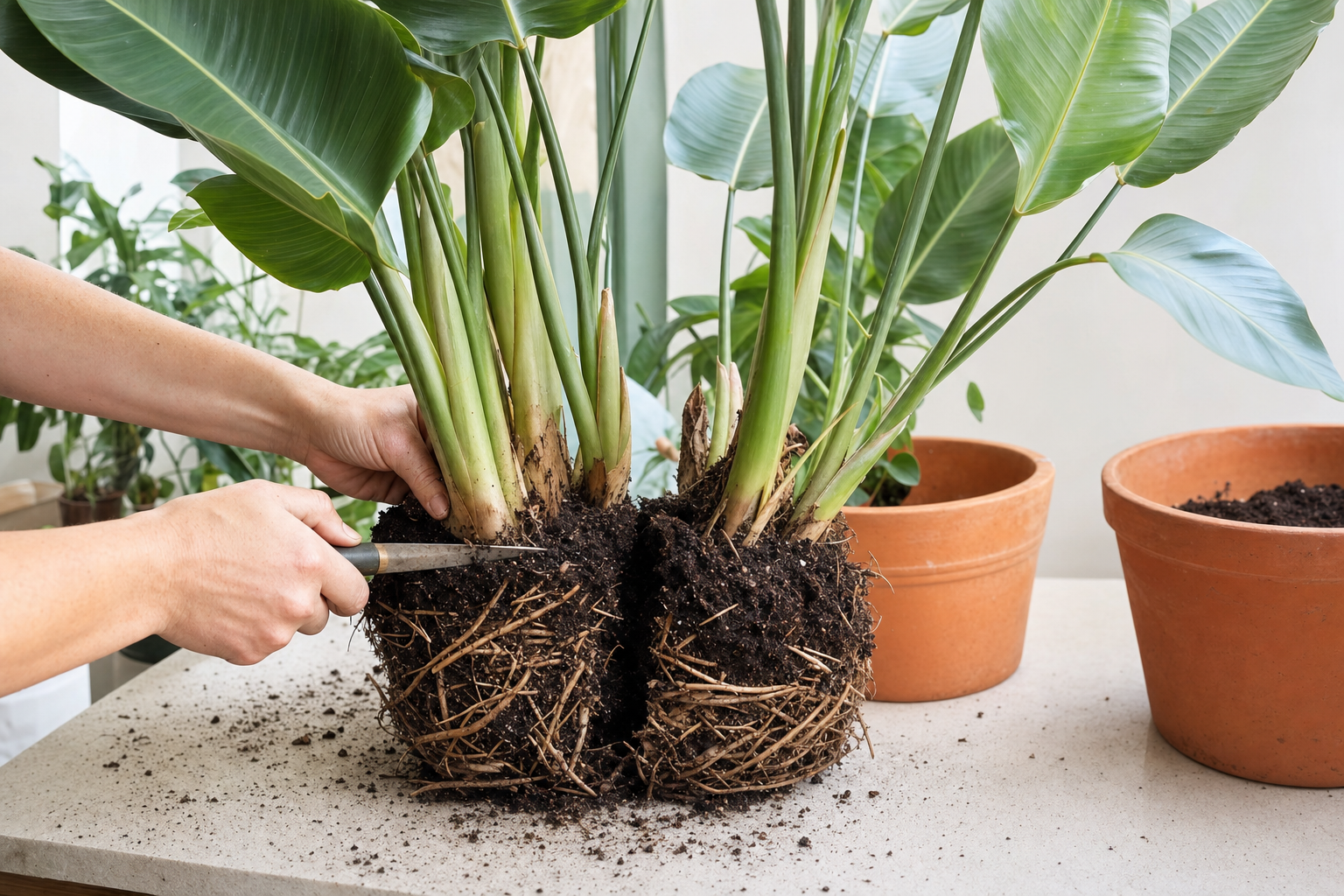
Division (recommended method)
You will need a clean sharp knife or pruning saw, a heavy ceramic or terracotta pot with drainage holes, well-draining potting mix, and optionally rooting hormone for cut root surfaces.
- 1 The best time to divide is in spring when the plant is entering active growth and can recover most quickly from root disturbance.
- 2 Water the plant thoroughly the day before to make root separation easier and reduce transplant shock.
- 3 Remove the entire plant from its pot — for large specimens this may require two people. Lay the plant on its side and gently slide the root ball out.
- 4 Examine the root ball and identify natural division points where clumps of stems (fans) have their own root systems. Bird of Paradise produces thick, fleshy rhizomes that connect the fans underground.
- 5 Using a clean, sharp knife or pruning saw, cut through the rhizome to separate sections, ensuring each division has at least 3–4 fans (stems) and a substantial root mass. Divisions with fewer fans can survive but take longer to recover and bloom.
- 6 Dust the cut surfaces with cinnamon powder or sulfur to prevent fungal infection at the wound sites.
- 7 Plant each division in its own pot with fresh well-draining soil, at the same depth as before. Use a heavy pot — Bird of Paradise is top-heavy and can tip over in lightweight containers.
- 8 Water thoroughly after planting and place in a warm, bright spot protected from direct sun for the first week.
- 9 Expect some shock — leaves may droop and one or two older fans may die back — but the division should stabilize within 2–3 weeks.
- 10 Resume normal care after 3–4 weeks, including monthly fertilizing during the growing season.
Expected timeline: new fan growth in 4–8 weeks, established plant in 3–4 months, first flowers possible within 1–2 years. Success rate: approximately 80–90% with divisions that have 3+ fans.
Success rate: approximately 80–90% with divisions that have 3+ fans.
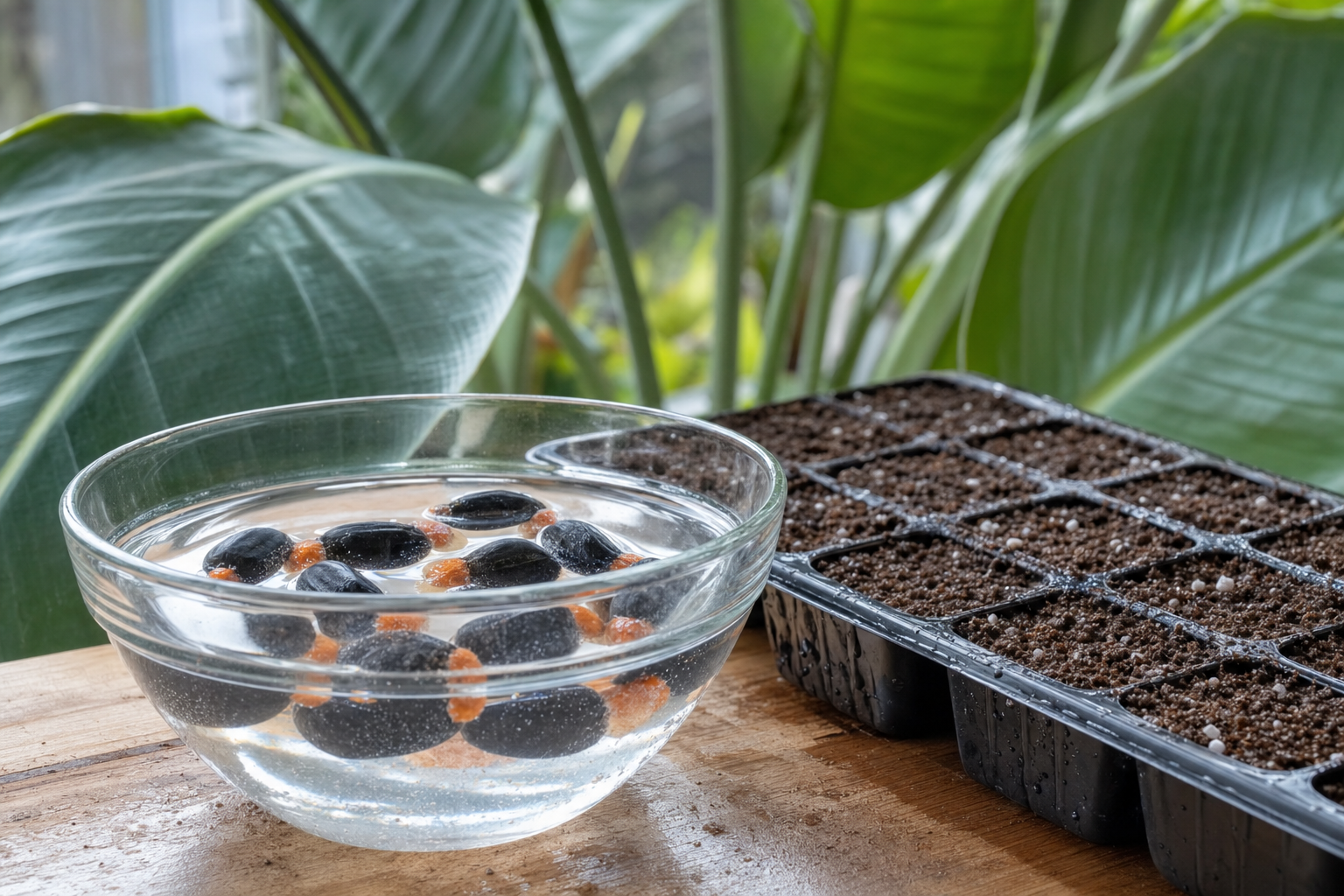
Seed propagation (for patient growers)
You will need fresh Bird of Paradise seeds (harvested from mature flowers or purchased), a seed-starting tray, sterile seed-starting mix, a heat mat, and a clear humidity dome or plastic wrap.
- 1 If harvesting your own seeds, wait until the seed pod on a spent flower turns dry and brown, then crack it open to reveal the black seeds with orange tufts.
- 2 Soak the seeds in room-temperature water for 24–48 hours to soften the hard seed coat — change the water once during soaking. Some growers also lightly nick the seed coat with a file or sandpaper (scarification) to improve water absorption.
- 3 Fill a seed tray with moist, sterile seed-starting mix.
- 4 Plant each seed about 1/2 inch deep and cover lightly with mix.
- 5 Cover the tray with a clear humidity dome or plastic wrap to maintain moisture.
- 6 Place on a heat mat set to 75–80°F (24–27°C) — warmth significantly improves germination rates.
- 7 Keep the soil consistently moist but not soggy, and provide bright indirect light.
- 8 Be extremely patient — germination can take anywhere from 1 to 3 months, and some seeds may take even longer.
- 9 Once seedlings have 2–3 true leaves, transplant them into individual small pots with well-draining soil.
- 10 Grow on in bright indirect light, watering when the top inch of soil is dry, and fertilizing monthly during spring and summer.
Expected timeline: germination in 1–3 months, first true leaves at 3–4 months, small established plant at 1 year, first flowers at 4–7 years. Success rate: approximately 40–60% for fresh seeds, lower for older seeds.
Success rate: approximately 40–60% for fresh seeds, lower for older seeds.
Troubleshooting Common Issues
Division wilting severely after separation
Some wilting is normal, but if the entire division is collapsing within days, the roots may have been damaged too extensively during separation. Ensure the soil is moist (not soggy) and increase humidity around the plant with a clear plastic bag tent. Remove any dead or dying fans so the plant directs energy to the surviving ones. Most divisions recover within 2–3 weeks if the root system is adequate.
No new growth after division
Bird of Paradise divisions can take 4–8 weeks before producing new fans, especially if divided in fall or winter. Ensure the plant is in bright indirect light and receiving consistent moisture. Avoid fertilizing for the first 6 weeks — the damaged roots cannot absorb nutrients efficiently and excess fertilizer can burn them. If after 3 months there is still no new growth, check the root system for rot by gently uncovering the soil surface.
Seeds not germinating
Bird of Paradise seeds are notoriously slow and inconsistent germinators. Ensure temperatures are consistently 75–80°F using a heat mat. Fresh seeds germinate much better than old ones — seeds older than 6 months have significantly reduced viability. Try scarifying (lightly filing) the seed coat before the next soaking. Keep the soil consistently moist — even one drying event can kill the embryo.
Seedling growing very slowly
This is normal for Bird of Paradise — they are slow-growing plants even in optimal conditions. Ensure bright indirect light, consistent moisture, and monthly diluted fertilizer during the growing season. Do not repot too frequently — slightly root-bound conditions encourage flowering maturity.
Propagation Tips
- ✓ Always use clean, sterilized tools to prevent infection
- ✓ Cuttings need bright indirect light — never direct sun
- ✓ Change propagation water every 5–7 days to prevent bacteria
- ✓ Be patient — rooting takes 2–6 weeks depending on the method
- ✓ Spring and summer are the best seasons for propagation