
How to Propagate Snake Plant
Snake Plant is one of the easiest houseplants to propagate. Here are three reliable methods — choose the one that fits your comfort level and available supplies.
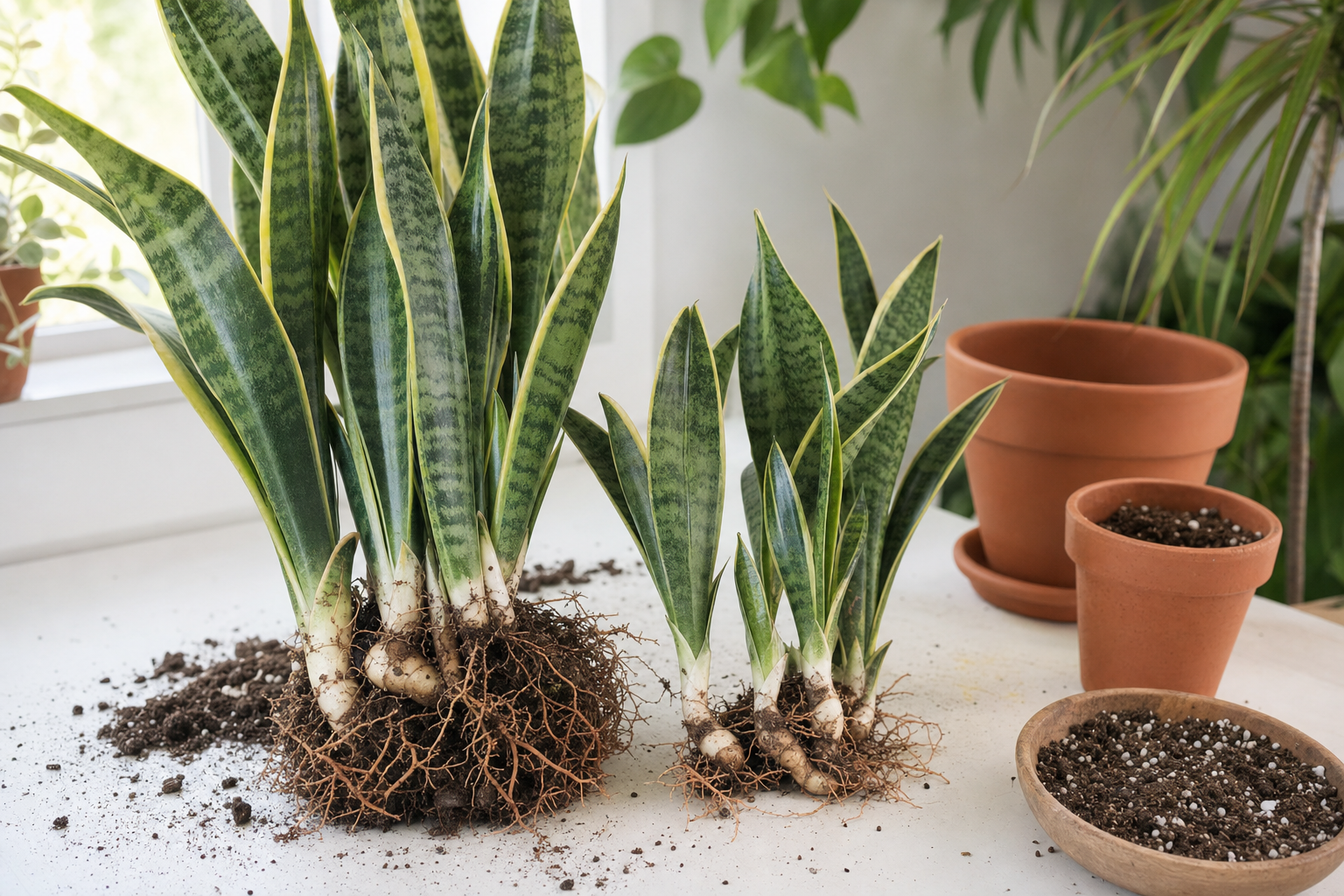
Division (fastest and most reliable)
This is the quickest path to a new, full-size plant and the only method that preserves variegation in varieties like Laurentii and Moonshine. You will need a clean sharp knife or pruning shears, fresh cactus/succulent potting mix, pots with drainage holes, and optionally rooting hormone.
- 1 Remove the entire plant from its pot during repotting — water the plant a day before to make this easier.
- 2 Gently shake off excess soil to expose the underground rhizomes connecting the mother plant to its pups (new rosettes).
- 3 Identify natural separation points where pups have their own root systems.
- 4 Using your hands, carefully tease the pup away from the mother plant, trying to keep as many of the pup's roots intact as possible. If the pup is firmly attached, use a clean, sharp knife to cut through the connecting rhizome, ensuring each division has its own roots.
- 5 Let the cut surfaces air-dry for 1–2 hours to callus, which helps prevent rot at the wound site.
- 6 Plant each division in its own pot with fresh succulent mix, positioning it at the same depth it was growing before.
- 7 Water lightly — just enough to settle the soil — and keep in bright indirect light.
- 8 Resume normal watering after 5–7 days, once the cut rhizome has had time to heal.
Expected timeline: the division continues growing with minimal pause, producing new leaves within 4–8 weeks. Full establishment takes about 2–3 months. Success rate: approximately 95–100% when each division has healthy roots attached.
Success rate: approximately 95–100% when each division has healthy roots attached.
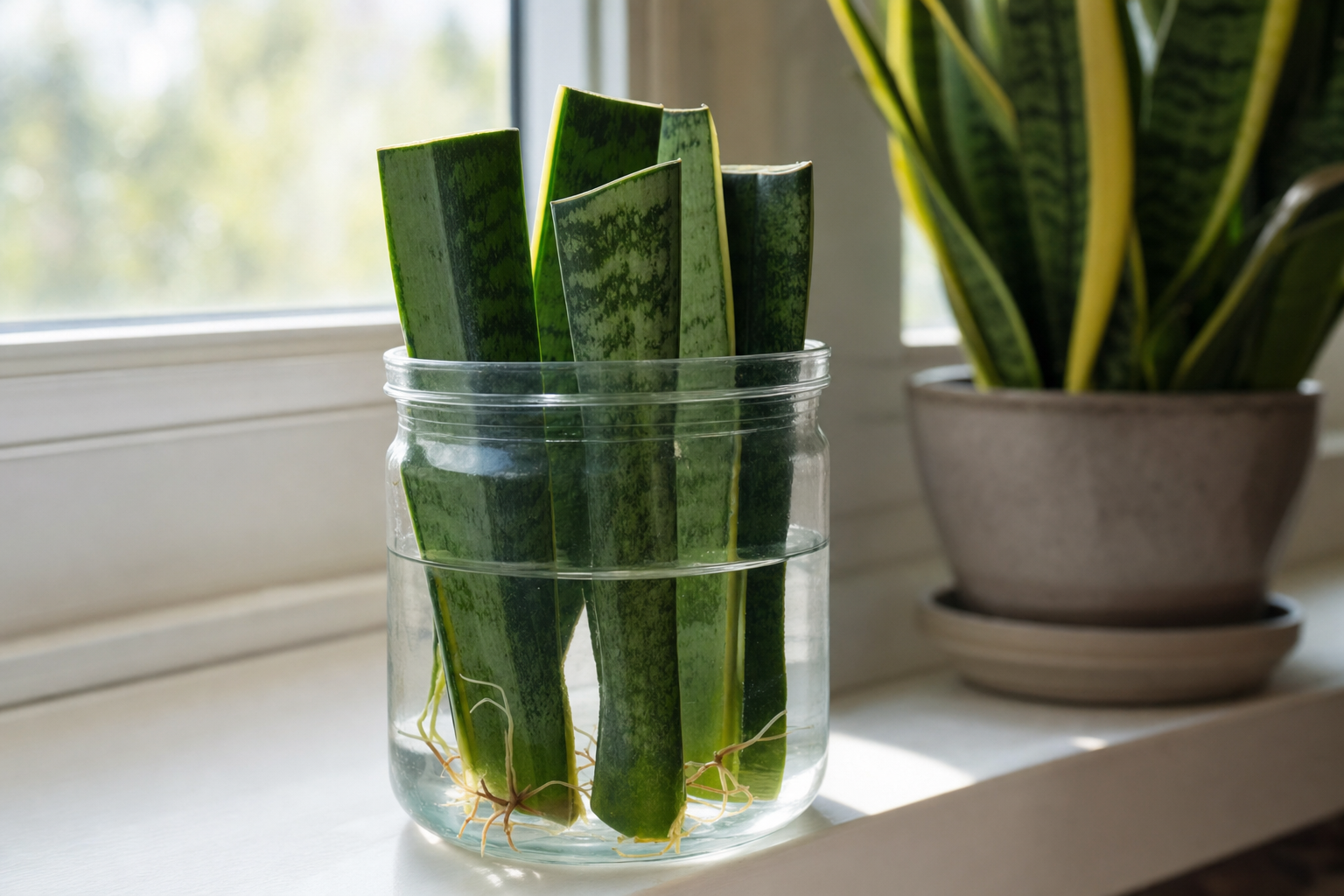
Leaf cuttings in water
This method is popular because you can watch roots develop, making it a great project for kids and beginners. You will need a healthy snake plant leaf, clean sharp scissors or a knife, a glass jar or vase, room-temperature water, and patience.
- 1 Select a healthy, mature leaf from the outer edge of the rosette — avoid very young or very old leaves.
- 2 Cut the leaf at its base where it meets the soil.
- 3 Cut the leaf into 3–4 inch sections using a clean blade.
- 4 Critically important — note which end of each section was closest to the soil. The cutting must be oriented correctly; planting it upside down will not produce roots. A helpful trick: cut the top of each section at a slight angle and the bottom straight across so you can tell them apart.
- 5 Place the bottom end in a jar of water, making sure only the bottom 1 inch is submerged — deeper submersion invites rot.
- 6 Place the jar in bright indirect light, avoiding direct sun which promotes algae.
- 7 Change the water every 7 days, rinsing the jar each time.
- 8 Watch for root emergence from the cut end, typically beginning in 3–4 weeks.
- 9 Once roots are 1–2 inches long (typically 6–8 weeks), and ideally once a small pup begins to form at the base, transplant into succulent soil mix.
- 10 Water sparingly for the first 2 weeks after transplanting to allow soil roots to develop.
Expected timeline: roots appear in 3–4 weeks, pup emerges at 8–12 weeks, transplantable plant by 12–16 weeks. Success rate: approximately 70–80%.
Success rate: approximately 70–80%.
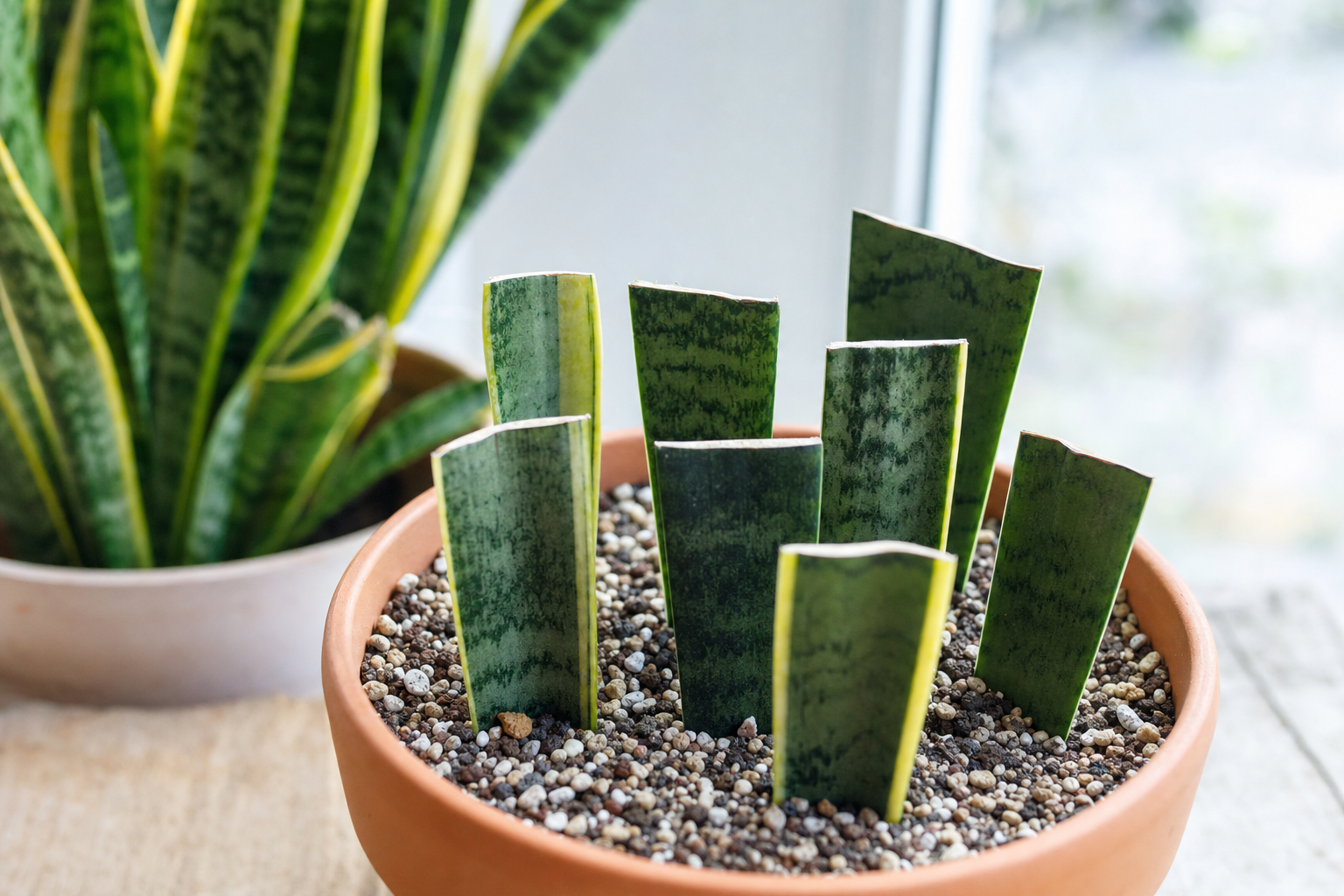
Leaf cuttings in soil
This method skips the water-to-soil transition and is preferred by experienced growers who find it produces sturdier plants. You will need a healthy snake plant leaf, clean sharp scissors or a knife, small pots with drainage holes, cactus/succulent potting mix, and optionally rooting hormone powder.
- 1 Prepare and cut the leaf into sections as described above, marking the orientation.
- 2 Let the cut ends callus for 1–2 days in a dry, shaded spot — this step is essential to prevent the moist cut surface from rotting in the soil.
- 3 Fill small pots with moist (not wet) succulent mix.
- 4 Dip the bottom cut end in rooting hormone if using, tapping off excess.
- 5 Insert the bottom end about 1 inch deep into the soil, firming the soil gently around it.
- 6 Place in bright indirect light and water very sparingly — only when the soil is completely dry, which may be every 2–3 weeks.
- 7 Be patient. Underground, a tiny rhizome forms at the base of the cutting before any visible growth appears above ground.
- 8 After 2–3 months, you may see a tiny new pup emerging from the soil at the base of the cutting — this is your new plant.
- 9 Once the pup has 2–3 leaves of its own, you can carefully separate it from the original leaf cutting and pot it on its own, or leave them together for a fuller appearance.
Expected timeline: rhizome formation at 6–10 weeks, pup emergence at 10–14 weeks, established new plant by 4–6 months. Success rate: approximately 65–75%.
Success rate: approximately 65–75%.
Important note for variegated varieties
Leaf cuttings from variegated snake plants (like Laurentii with yellow margins or Moonshine with silver coloring) almost always revert to solid green. This happens because the meristematic tissue at the cut edge produces genetically reversioned growth. To preserve variegation, always use the division method instead. If you do try leaf cuttings with a variegated variety, expect the new pup to emerge as a solid green form — still a perfectly healthy snake plant, just without the colorful margins.
Troubleshooting Common Issues
Leaf cuttings rotting in water
If the cut end turns brown, mushy, or slimy and the water becomes cloudy or foul-smelling, bacterial rot has set in. Remove the affected cutting immediately. If any portion of the leaf section is still firm and green, recut it with a sterilized blade 1 inch above the rot line, let it callus for 24 hours, and restart in fresh water with a clean jar. Adding a small piece of activated charcoal to the water can help inhibit bacterial growth. The most common cause is submerging the cutting too deeply or failing to change the water regularly.
No roots after 4–6 weeks
Snake plant leaf cuttings are notoriously slow to root, and patience is often the only solution. However, if absolutely nothing is happening after 6 weeks, check the temperature — cuttings root fastest at 70–80°F (21–27°C). Move them to a warmer spot with brighter indirect light. Cuttings taken in fall or winter will root significantly slower due to shorter days and cooler temperatures; a propagation heat mat can help. Also ensure the correct end of the cutting is in the water or soil — an upside-down cutting will never root.
New pup wilting or shriveling after transplant
If a newly transplanted pup or division begins to look wrinkled or wilted, it is usually struggling to establish soil roots after being in water. The key is to maintain slightly higher humidity around the plant for the first 2 weeks — a clear plastic bag loosely placed over the pot creates a mini greenhouse. Keep the soil barely moist (not wet) and avoid fertilizing for at least a month. Most transplants recover within 2–3 weeks as soil roots develop. If the soil is wet and the base is mushy, you have overwatered — remove the plant, trim any rotten roots, let it dry for a day, and repot in fresh dry succulent mix.
Variegated cutting produced an all-green pup
This is not a problem you can fix — it is a genetic certainty. Leaf cuttings from variegated Sansevieria varieties will not produce variegated offspring because the new growth emerges from genetically reversioned tissue. To propagate a variegated snake plant that keeps its coloring, you must use the division method, which preserves the original genetic makeup of the mother plant.
Propagation Tips
- ✓ Always use clean, sterilized tools to prevent infection
- ✓ Cuttings need bright indirect light — never direct sun
- ✓ Change propagation water every 5–7 days to prevent bacteria
- ✓ Be patient — rooting takes 2–6 weeks depending on the method
- ✓ Spring and summer are the best seasons for propagation